
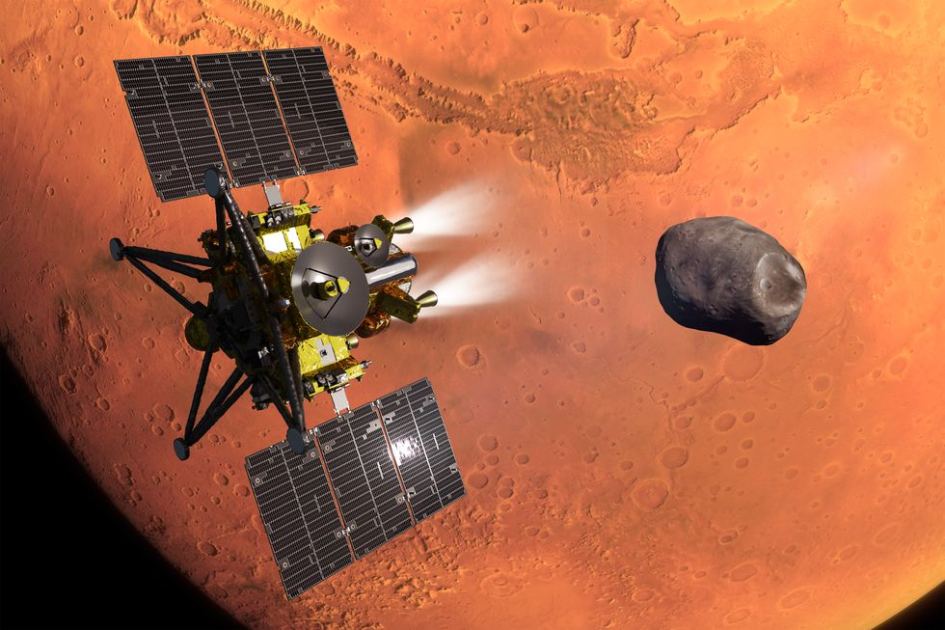
Last August, looking up from the edge of an ancient river delta on Mars, the Perseverance rover’s electronic eye spied an oblong shadow crossing the distant, glowing Sun. Phobos, the Martian moon named for the Greek god of fear and panic, was transiting the solar disk. Too small to darken the pale, dust-tinged sky, but orbiting close enough to eclipse a significant fraction of the Sun, Phobos passed in less than a minute. NASA’s Perseverance rover captured Phobos passing in front of the Sun from the surface of Mars.ASU/MSSS/SSI/JPL-Caltech/NASAThe tiny moon, with its murky origins, is an enigma, and one whose makeup and history could tell us much about Mars and the wider solar system. And now the international Martian Moons eXploration (MMX) mission, which successfully launched on 20 October, seeks to explore that mystery with an unprecedented series of landings on the unknown surface of Phobos.This mission brings unusual challenges—for example, designing an orbit to study a mi
UPVOTERS
Community appreciation
See who found this content valuable and showed their support.
No upvotes yet.
Be the first to show your appreciation for this content.
TOPICS
Explore the same topics
Discover more content from the topics this post is mapped to.
Keep browsing
Explore more from this topic
Dive into the full feed of curated posts covering Robotics & Automation.
Discussion
Say something first
It all starts with you—share your thoughts now.