
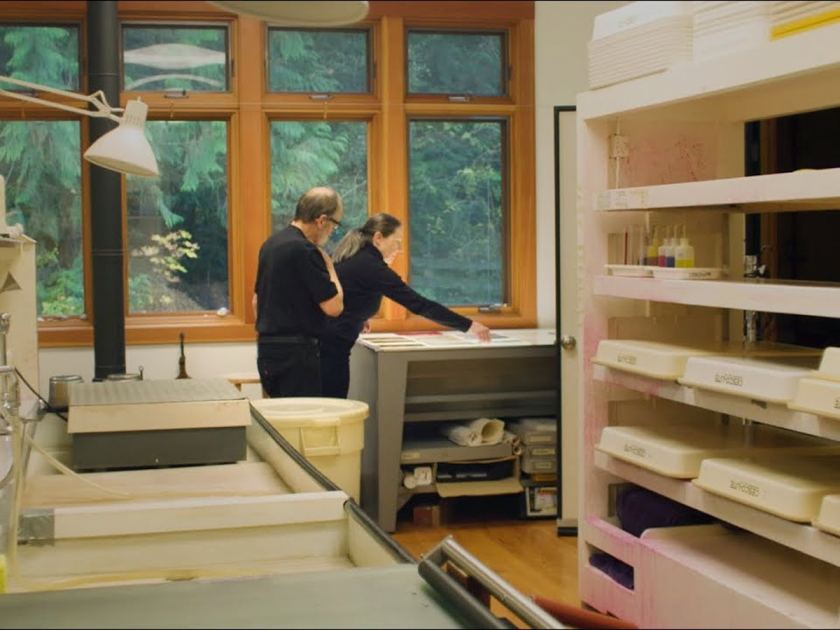
Few photographers are as synonymous with richly saturated color as William Eggleston, but the complexity behind making his prints is often underappreciated. In this behind-the-scenes look, longtime collaborators and master printers Guy Stricherz and Irene Malli walk through every stage of his dye-transfer process, revealing just how much work goes into each print. Eggleston discovered the dye-transfer process in the 1970s, a crucial step that enabled him to move from black-and-white to color photography. Stricherz and Malli have been printing his photographs for the last 25 years, and the video reveals their meticulous workflow that turns a single transparency into three color-separation negatives and, ultimately, one luminous final print. Over the course of the video, you see how laboratory immersion oil, spotless glass, and carefully controlled enlarger exposures give way to Kodak Matrix film, darkroom processing, and delicate gelatin reliefs that hold each dye. From there, Stricher
UPVOTERS
Community appreciation
See who found this content valuable and showed their support.
No upvotes yet.
Be the first to show your appreciation for this content.
TOPICS
Explore the same topics
Discover more content from the topics this post is mapped to.
Keep browsing
Explore more from this topic
Dive into the full feed of curated posts covering Food Photography & Styling.
Discussion
Be the first to comment
Add your perspective to get the discussion started.