
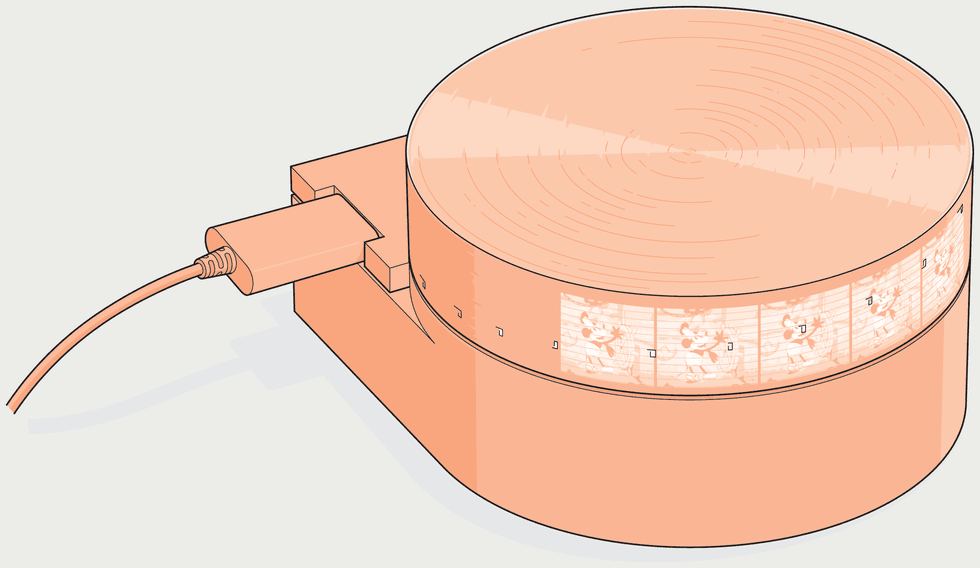
I never intended to join the cutting edge of electromechanical television. I just wanted to make a nice clock. But sometimes you have to go where the engineering takes you, and in my case it took me to the Scanwheel, a pocket-size wide-screen electromechanical TV with a resolution of 4,096 by 20 pixels. Yup, that’s 4K by 20. The 3D-printed drum [top] is spun by a motor controlled by a driver board [second row, from top]. The driver board, in turn, is controlled by a Raspberry Pi Pico [middle], which also controls the LEDs [second row, from bottom], which are mounted in the 3D-printed casing [bottom] so that the holes pass over them as the drum turns.James ProvostElectromechanical television was the first form of practical television, developed by John Logie Baird in the 1920s. He used a so-called Nipkow disk, which has a spiral of holes punched through it. As the disk rotates, the holes pass one by one in front of a light source. By varying the brightness of the light as a hole tr
UPVOTERS
Community appreciation
See who found this content valuable and showed their support.
No upvotes yet.
Be the first to show your appreciation for this content.
TOPICS
Explore the same topics
Discover more content from the topics this post is mapped to.
Keep browsing
Explore more from this topic
Dive into the full feed of curated posts covering Robotics & Automation.
Discussion
Your thoughts matter!
Your input is valuable—be the first to share it!