
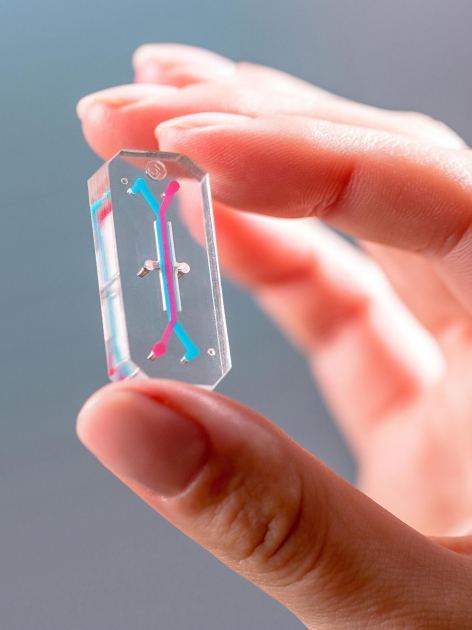
Seventeen years ago, cell biologist Donald Ingber and his colleagues at Harvard University’s Wyss Institute for Biologically Inspired Engineering submitted a paper to the journal Science describing their model human lung. It was smaller than a USB stick and made of a clear polymer slab containing narrow channels, which were lined with the type of cells that line a lung’s air sacs and blood vessels. When air was pumped through hollow chambers beside the channels, the device rhythmically expanded and contracted—it “breathed.”This lifelike movement was a dramatic change from previous generations of lung models, which typically used static cultures of lung tissue that were unable to simulate the movements essential to lung function. When exposed to inflammatory proteins and bacteria, Ingber’s artificial lung reacted much as living lungs would. And exposure to silica nanoparticles used to model the effects of ultrafine particulates revealed that movement affected how tissues ab
UPVOTERS
Community appreciation
See who found this content valuable and showed their support.
No upvotes yet.
Be the first to show your appreciation for this content.
TOPICS
Explore the same topics
Discover more content from the topics this post is mapped to.
Keep browsing
Explore more from this topic
Dive into the full feed of curated posts covering Robotics & Automation.
Discussion
Break the silence
Take the opportunity to kick things off.